Land scarcity and overcrowding in Lipce
The PeasantsLand scarcity and overcrowding in Lipce form a persistent material crisis rather than a mere quarrel between generations. Too little land supports too many people, and the lack of money prevents the young from buying more; the result is pressure on family farms, crowded homes, insecure work, and a widening divide between those who own resources and those who cannot secure them.
A village pressed against its limits
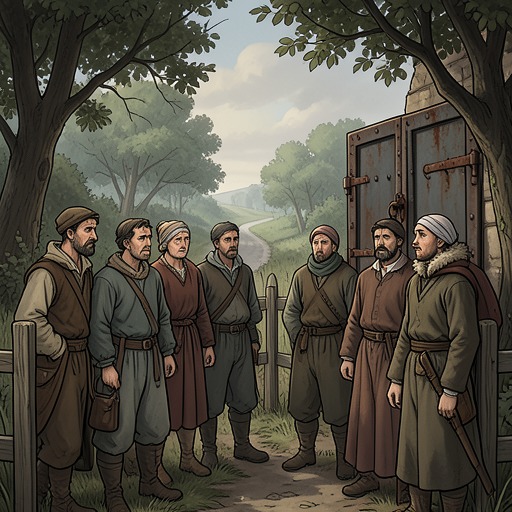
The villagers see the contrast most sharply in the fertile land at Podlesie. It lies beside their own holdings, and each family can imagine what even a few morgen would mean: room for sons and sons-in-law, better meadows, and water nearby. Instead, the German settlers of Podlesie have acquired the land. The villagers picture the settlers becoming masters there while Lipce’s own people remain crowded on narrow strips, struggling to get from one harvest to the next. The loss is therefore both practical and intimate: a nearby possibility of expansion becomes a visible reminder of what the villagers cannot afford.
That frustration is inseparable from population pressure. The cottages are full, the young people linger in the lanes without an evident prospect of establishing households, and the villagers ask where everyone is supposed to go. Buying land might answer that question, but there is barely enough money for daily needs. They even seek counsel from The Parish Priest of Lipce, who can offer no solution to a problem for which the village has no funds. Their predicament is not a failure to imagine what would help; it is the inability to pay for it.
Inheritance cannot create land
When young men blame their fathers for not handing over larger portions, Grzela rebukes them. The older farmers, he points out, can barely live from their entire holdings; dividing those farms further cannot make the younger generation prosperous. His argument identifies the limit of a purely familial explanation: even a transfer of property would redistribute scarcity, not remove it.
Grzela states the underlying change in scale directly. What provided enough land for three people in their grandfathers’ time must now be divided among ten. The villagers recognize the force of this comparison and fall quiet before agreeing that it is true. Their response gives the shortage a historical dimension: the inherited pattern of holding land has not kept pace with the number of people who depend on it. Yet recognizing the cause does not supply a remedy. Someone proposes that the village buy Podlesie, but Mateusz immediately asks where the money could come from. The proposed purchase exposes the same trap as the appeal to inheritance: land is necessary, but the poor cannot acquire it.
Mateusz voices the consequences as a personal breaking point. He threatens to leave Lipce for town, where he imagines people live better, then describes a village so crowded that its houses seem ready to fall apart and its residents so poor they can scarcely make ends meet. Nearby land appears available, but hunger does not give the villagers the means to buy it, and no one will lend them the money. His anger turns a demographic and economic condition into a judgment on a system that leaves usable land beyond the reach of those who need it.
Scarcity and the struggle for work
The pressure of land shortage converges with the need for wages. In winter, at least twenty hired hands in the village are desperate for work; some have already lost their potatoes to frost, and money is not coming in. A resident fears that the preharvest period will be exceptionally lean, with some households eating a hot meal only once a day and going to bed hungry. The villagers had expected the felling at Wolf’s Hollow to provide work for everyone. Instead, The Squire is said to have resolved not to employ a single man from Lipce, angered by a complaint made against him to the commissioner.
This refusal makes the forest dispute more than a contest over trees. Employment from the felling had been counted on as a short-term answer to winter hardship; its withdrawal removes income precisely when households have little reserve. A villager who signed the complaint insists on standing by it and declares that no fir should be cut until the manor reaches an agreement and gives the villagers what they consider theirs. The stance carries a cost: resistance may prevent access to the expected work, yet accepting the felling without a settlement would leave the community exposed to the manor’s decisions over both resources and livelihood.
When the conflict reaches a public appeal, the argument gathers these injuries together. The speaker addresses farmers and hired hands as people who have suffered injustice, naming the manor’s felling of the forest, its refusal to employ the villagers, and its repeated harassment of them. He recalls complaints and legal action that have brought no relief, then presents the cutting of the wood as the last straw. The crowd responds with calls to drive the workers away and stop the felling. Its anger emerges from several connected pressures: customary claims to the forest, lost employment, and a broader sense that no effective authority will protect the villagers.
Poverty within the crowded community
The effects are especially stark in the accounts of poor households during the men’s imprisonment. A daughter in Filipka’s household is thought to be dying, but hunger, not a fatal illness, is the immediate danger. The cottage is bitterly cold; straw stuffs the windows; several family members crowd together for warmth and bedding. The household has run out of potatoes and sold its quilt. It must beg the miller for groats, while credit and loans are difficult to obtain before harvest. With Filipka’s husband in prison, the family has lost both income and support at a moment when it has almost no reserves.
A second account makes clear that the crisis is not confined to one household. Florka gives birth to a healthy boy while sick, without savings, and too weak to nurse him; the cow is only just coming into calf. Her fields stand fallow because her husband is among the imprisoned men and there is no one to work them. Around her, laborers have no work or earnings. The shortage of land is thus intensified by the shortage of labor and cash: families may possess a plot, yet imprisonment, illness, hunger, or the absence of workers can prevent them from cultivating it or living from it.
The village’s resources are not shared evenly. One critic observes that farmers attend to their own food and lending at the highest interest, while the poor are left to divine care. The two groups live in the same village, separated only by a boundary, but proximity does not ensure assistance. The account names The Miller, the priest, and the organist among those who might be able to help, while acknowledging that help depends on a willingness to act. Land scarcity and overcrowding therefore describe more than a shortage of acreage: they expose the unequal access to credit, employment, food, and neighborly support that determines who can endure it.